

Nominiert für die Shortlist der Jury 2026 - Nachwuchsarbeiten
Ghat Connector: Reimagining the bridge within the flood-ridden metropolis Dhaka (Bangladesh)
© Friedrich Mönninger

© Friedrich Mönninger
© Friedrich Mönninger
© Friedrich Mönninger
© Friedrich Mönninger
© Friedrich Mönninger
© Friedrich Mönninger
Diese Objektpräsentation wurde angelegt von: Technische Universität München, Chair of Architectural Design & Participation, Friedrich Mönninger
Basisdaten zum Objekt
Lage des Objektes
1209 Dhaka, Bangladesh
Objektkategorie
Objektart
Art der Baumaßnahme
Neubau
Fertigstellungstermin
04.2025
Zeichnungen und Unterlagen

Projektbeteiligte Firmen und Personen
Verwendete Produkte

Gebäudedaten
Bauweise
Holzbau
Tragwerkskonstruktion
Holz
Anzahl der Vollgeschosse
2-geschossig
Raummaße und Flächen
Bruttogrundfläche
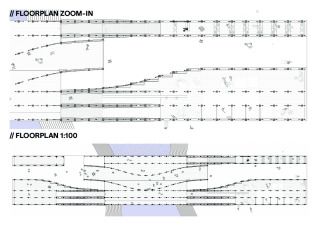
4.420 m²
Nutzfläche
3.220 m²
Verkehrsfläche
1.200 m²
Kosten
Veranschlagte Rohbaukosten des Bauwerks
450.000 Euro
Gesamtkosten der Maßnahme (ohne Grundstück)
500.000 Euro
Beschreibung
Objektbeschreibung
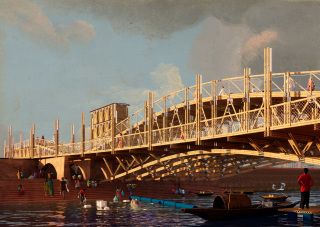
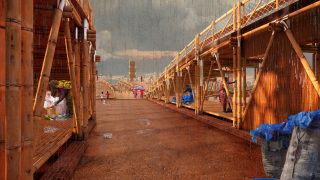
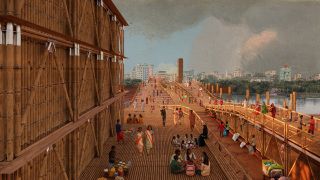
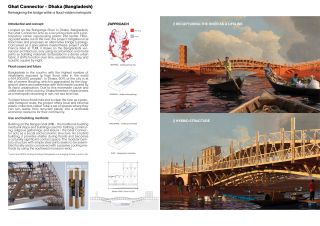
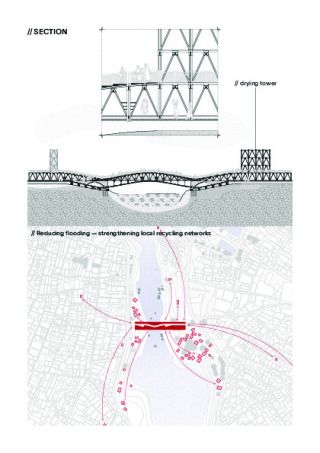
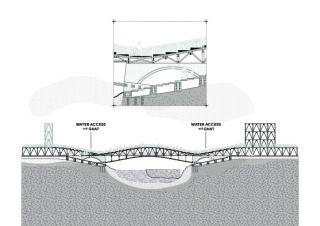
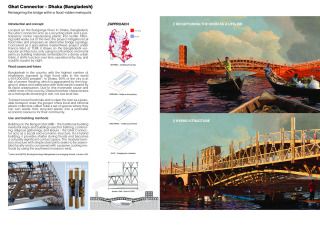
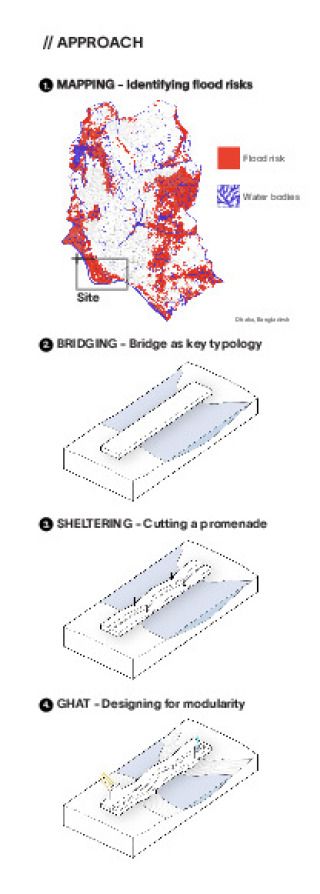
Located on the Buriganga River in Dhaka, Bangladesh, the Ghat Connector acts as a recycling plant and a participatory center repurposing plastic into textile. Filtering solid waste out of the river, the project mitigates local flood risks and proposes an alternative bridge typology. Conceived as a speculative masterthesis-project under Prof. Francis Kéré at Technical University of Munich (TUM), it draws on the Bangladeshi vernacular architecture, only using local bamboo and metal joints as building materials. Embedded in a dense urban fabric, it shifts function over time, operational by day, and a public square by night.
Flood causes and future lookout
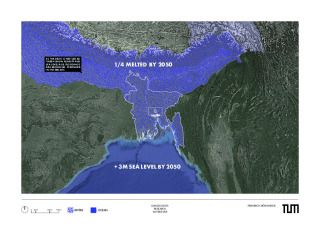
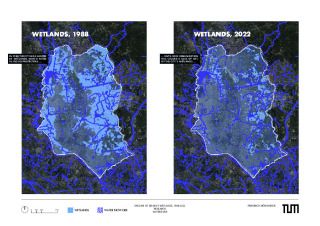
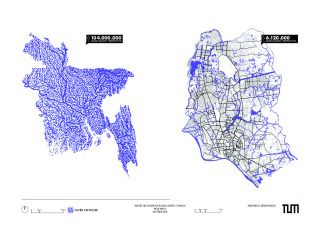
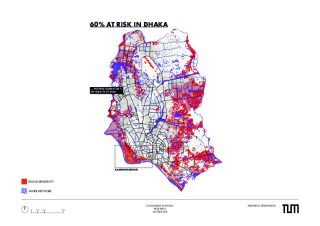
Bangladesh is the country with the highest number of inhabitants exposed to high flood risks in the world (>104.000.000 people)1. In Dhaka, 60% of the city is at risk of severe flooding, which is aggravated by the clogging of drains and waterways with solid waste caused by its rapid urbanization. Due to this manmade cause and unlike most of the country, Dhaka therefore characterizes as a metropolis drowning in rain, not sea level rise.
To lower future flood risks and to clear the river as a passable transport route, the project offers local and informal plastic collectors called Tokai a set of spaces where they can turn textile from recycled plastic into a profitable economic resource for their community.
Use and building methods
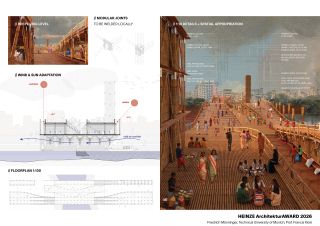
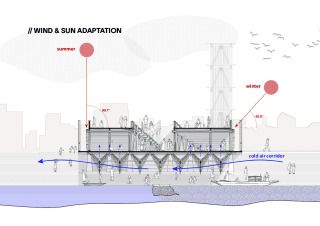
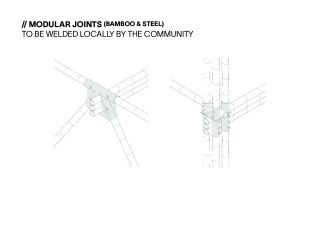
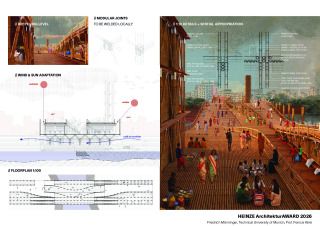
Building on the Bengal Ghat (ঘাট) - the traditional bustling riverbank steps and buildings used for bathing, commuting, religious gatherings, and leisure - the Ghat Connector acts as a social and economic structure. As a hybrid building, it provides shelter during floods and becomes a culturally significant contact space. The modular bamboo structure with simple steel joints seeks to be assembled locally and is conceived with a passive cooling methods by using the southwest monsoon wind.
Beschreibung der Besonderheiten
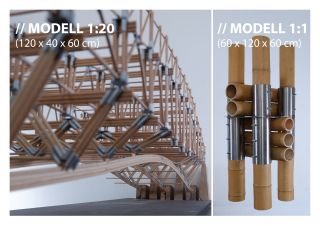
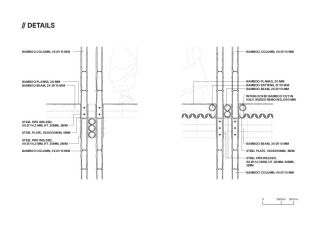
The Master thesis was conceived after a reseach stay, completed an internship at Marina Tabassum Architects in Dhaka, Bangladesh, where site-specific knowledge was obtained by visiting and speaking to the local community aftected by flooding. By discussing with local artisans and producers, the project incorporated structural details that are locally buildable by the community. To further prove the buildability of the project, mock ups of the structural elements were build up to the model scale 1:1.
Nachhaltigkeit
The Ghat Connector project follows an integrated energy and material concept based on the principles of efficiency, consistency, and sufficiency. Material selection prioritizes durable, low-maintenance, and locally available resources (bamboo) to minimize embodied energy and transportation impacts (transported by the Buriganga river). The structural design is optimized to use materials efficiently while ensuring long-term performance and resilience in the local climate.
Cradle-to-Cradle
Following Cradle-to-Cradle principles, the bridge is conceived as a material cycle: bamboo components can biodegrade naturally at the end of their service life and be replaced as in a modular sense, while the metal connectors have a longer service life and can be disassembled and recycled at the end of their service cycle. Overall, the project aims to balance environmental responsibility, functional performance, and social value within the urban context of Dhaka.
Auszeichnungen
Presented at the Architectural Symposium "Water & Time in Architectural Education" at ETH Zurich (CH) / ZAZ Bellerive – Zentrum Architektur Zurich (CH)
Schlagworte
Energetische Kennwerte
Energiestandard
Objektdetails
Gebäudespezifische Merkmale
Anzahl Arbeitsplätze
60
Anzahl Klassen
6
Anzahl Schüler
60
